Single-use technologies have become integral to modern biopharmaceutical manufacturing, supporting faster, more flexible production in an increasingly complex regulatory landscape. As adoption accelerates, the need for clear, consistent communication between end-users and suppliers has never been more critical. Yet effectively communicating single-use system (SUS) requirements remains a challenge across the industry, often revealing gaps in expectations between end-users and suppliers. 

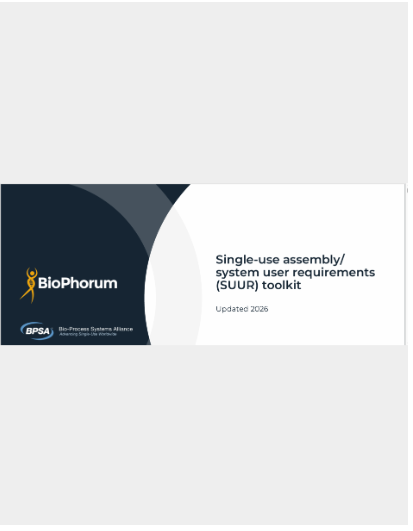
We wanted to equip the industry with common tools to enable clear and consistent communication of user requirements and supplier capabilities in accordance with industry standards. BioPhorum, in collaboration with the BPSA, has therefore published an updated edition of the Single-Use User Requirements (SUUR) Toolkit – Implementation & Use. This update reflects both current regulatory expectations and the practical experience gained since its original release in 2019. 

The Toolkit is a collection of standard templates to support SUS design and qualification, facilitating right-first-time implementation. It includes a user requirements template, supply chain memo template and a supporting ‘how to’ and implementation guide. It equips the industry with common tools to enable clear and consistent communication of user requirements and supplier capabilities when building SUS for an end-user application. 

SUURs allow end-users to communicate process/application details and single-use requirements to suppliers, and allow suppliers to affirm or describe their capabilities to meet these requirements. The Toolkit uses consistent terminology in a logical structure of simple, categorized requirements. 

The supply chain memo template is an additional, optional template that allows end-users to communicate requests for supply-chain-related information at the component level to suppliers, providing transparency of the supply chain for a SUS and enabling understanding and management of risk.  

So what is new and why does it matter? 

  • The updated guidance is now aligned with ASTM E3051-25, EU GMP Annex 1 and BPSA Quality Test Matrices 
  • It contains practical, step-by-step recommendations for implementing SUURs across organizations and supply chains 
  • It has an expanded focus on cross-functional engagement between manufacturing, quality, engineering, sourcing and suppliers 
  • It contains clear guidance on how to use the SUUR template and optional supply chain memo to improve transparency, reduce rework and accelerate ‘right first time’ execution 
  • It includes real-world considerations for rollout, governance and change management. 

The SUUR Toolkit adds significant value to the industry by establishing a common language and a structured approach for defining requirements and confirming supplier capabilities. This reduces misalignment, mitigates risk and supports faster, more robust implementations of SUS. 

For end-users, the Toolkit minimizes non-conformances and regulatory risks caused by gaps in expectations with suppliers. It also reduces implementation timelines for new designs, minimizes supply disruptions, and facilitates second sourcing by comparing supplier responses like-for-like. 

For suppliers, the Toolkit deepens the understanding of customer application and requirements up front, ensuring that designs are fit for use. It also provides consistency in the content and format of user requirements, reducing the time and resources required to respond by preparing standard responses in advance. 

Developed collaboratively by end-users and suppliers, this update reinforces SUURs as a foundational best practice for designing, qualifying and implementing SUS in today’s regulatory and supply-constrained environment, and will help drive consistency, transparency and confidence across SUS design and supply. 

Click here to download the new SingleUse User Requirements (SUUR) Toolkit – Implementation & Use 

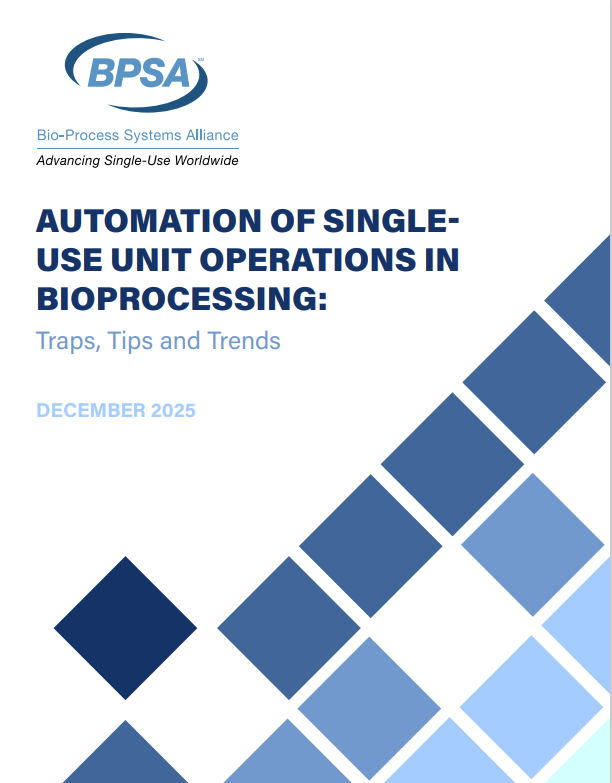
December 17, 2025, (ARLINGTON, VA) – The Bio-Process Systems Alliance (BPSA) is pleased to announce the publication of its latest technical resource, Automation of Single-Use Unit Operations in Bioprocessing: Traps, Tips & Trends.   

Automation in bioprocessing—especially for single-use systems—can boost efficiency and consistency, enable real-time control, and support flexible and scalable manufacturing. This comprehensive white paper provides practical guidance for suppliers and end-users of single-use systems integrating automation into single-use bioprocesses. The document presents the perspective of two personas with different backgrounds in automation and single-use technologies, and addresses key topics including:  

-Fundamentals of automation and control strategies for single-use systems
-Common pitfalls and best practices for implementation
-Real-world examples of highly automated bioprocessing facilities
-Insights on digital communication and data integrity  

Developed by the BPSA Automation Committee, this white paper aims to bridge the knowledge gap between automation engineers and single-use technology specialists. It is designed to help companies improve efficiency, reduce risk, and accelerate innovation in bioprocessing.  

“This white paper represents a significant step forward in helping our industry automate systems and processes, enabling us to get important, life-saving products to our customers, patients and consumers faster. I especially want to thank the two co-chairs of the BPSA Automation Committee, Stuart Tindal, EngD, PhD of Sartorius, and Hernan Parma of Renolit Healthcare, for their leadership,” said Chris Clark, BPSA Executive Director. “I also want to thank and congratulate the broader BPSA Automation Committee for their dedication and collaboration in producing this important BPSA resource.”

The white paper is now available for download at: https://www2.bpsalliance.org/forms/store/ProductFormPublic/automation-of-single-use-unit-operations-in-bioprocessing-traps-tips-and-trends    

About BPSA 
The Bio-Process Systems Alliance (BPSA) is an industry-led trade association dedicated to advancing the adoption and implementation of single-use technologies in biopharmaceutical manufacturing. For more information, visit www.bpsalliance.org.     

Contact:
Christopher Clark
Executive Director
571-348-5109
cclark@socma.org

Arlington, VA – The Bio-Process Systems Alliance (BPSA) is pleased to announce the release of a new FAQ resource on the integrity assurance of single-use systems (SUS). These FAQs, developed by BPSA’s Integrity Assurance Committee, address common industry questions about the integrity and testing of single-use systems and components. They are designed to assist both manufacturers and end-users in ensuring the integrity of their single-use systems throughout the bioprocessing lifecycle.

Key FAQs Include:

  • Is it possible to perform a leak/integrity test on SUS post-use?
  • Why is it often recommended to use a porous spacer when testing SUS in its container?
  • Does the compressed air used to perform a leak/integrity test at the supplier(s)’ site need to be filtered?
  • Will the leak/integrity test damage my SUS product?
  • What is the difference between a leak test and an integrity test?

These integrity assurance FAQs are the first in a series of FAQs and will be updated as needed by BPSA. In addition to these FAQs, BPSA offers comprehensive technical guides on SUS integrity assurance in its industry resources library. In 2017, BPSA published the Design, Control, and Monitoring of Single-Use Systems for Integrity Assurance, which provided recommendations for both suppliers and end-users regarding strategies, tools, and procedures to enhance the integrity assurance of single-use systems. In 2023, BPSA published Design, Control & Monitoring of SUS for Integrity Assurance: Volume 2, as a follow-up to the 2017 guide.

These resources are essential tools for companies looking to enhance the reliability and safety of their single-use technologies. “I want to thank the BPSA Integrity Assurance Committee, and its Chair, Patrick Evrard of Cytiva, for their leadership and hard work in developing these FAQs,” said BPSA Executive Director, Chris Clark. “SUS Integrity has always been a crucial quality attribute for suppliers, end-users, and regulatory authorities, and the new Annex 1 makes it even more critical.  These FAQs will play a key role in advancing both the use and integrity of single-use systems.”

Submit Your Questions:

If you have additional questions about SUS integrity assurance, you can submit them to bpsa@socma.org. All inquiries will be reviewed by BPSA’s Integrity Assurance Committee, and the most relevant questions will be added to the list of FAQs as the resource is updated.

For more information about BPSA industry resources or joining the BPSA member network and technical committees, visit the BPSA website or contact us at bpsa@socma.org.

About BPSA

The Bio-Process Systems Alliance (BPSA), an affiliate of SOCMA, was formed in 2005 as an industry-led international industry association dedicated to encouraging and accelerating the adoption of single-use manufacturing technologies used in the production of biopharmaceuticals and vaccines. www.bpsalliance.org.

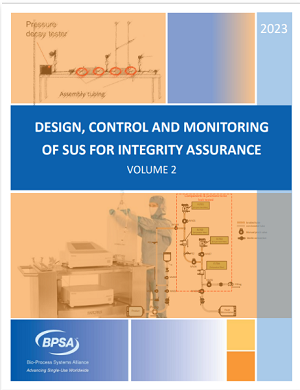
ARLINGTON, VA – The Bio-Process Systems Alliance (BPSA) announced the release of its latest guide, Design, Control & Monitoring of SUS for Integrity Assurance: Volume 2, which serves to follow up to BPSA’s 2017 guide, Design, Control & Monitoring of SUS for Integrity Assurance.

The increasing use of single-use technologies (SUTs) in bioprocessing has made integrity assurance a critical quality attribute for both suppliers and end-users of SUTs. In 2017, the BPSA published the Design, Control, and Monitoring of Single-Use Systems for Integrity Assurance that provided recommendations to both suppliers and end-users in the single-use technology industry regarding strategies, tools and procedures that can assist in providing enhanced assurance of integrity of single-use systems.

This 49-page guide (Volume 2) provides case studies illustrating the principles developed in Volume 1; updates to key technologies used by the industry; updates to the regulatory landscape and industry guidance, and case studies covering specific applications such as elevated pressure situations and containment of powders. The guide also addresses essential concepts such as Quality by Design (QbD) and fostering collaboration between suppliers and end-users.

“The bioprocessing industry has made tremendous progress on leak and integrity testing of SUS over the past few years, and the examples and case studies included in this guide illustrate the progress the single-use industry has made,” said Patrick Evrard of Cytiva, and Chair of the BPSA Integrity Assurance Committee.

“I want to thank the BPSA Integrity Assurance Committee, and its Chair, Patrick Evrard of Cytiva, for their leadership and hard work on this guide,” said BPSA Executive Director, Chris Clark. “This guide is an important tool for suppliers and end-users alike and supports our mission of driving the adoption of SUS worldwide.”

Please visit  https://bpsalliance.org/technical-guides to download the guide.

About BPSA The Bio-Process Systems Alliance (BPSA), an affiliate of SOCMA, was formed in 2005 as an industry-led international industry association dedicated to encouraging and accelerating the adoption of single-use manufacturing technologies used in the production of biopharmaceuticals and vaccines. www.bpsalliance.org.